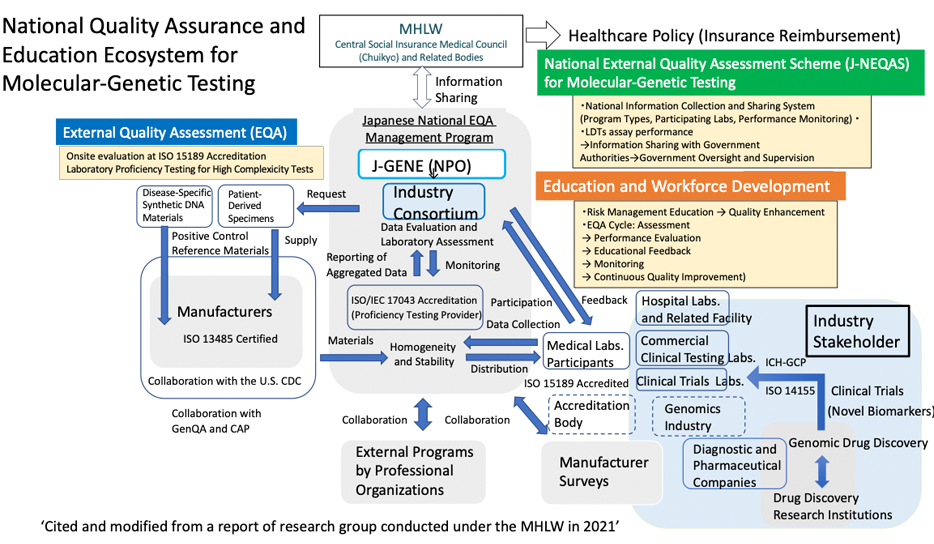
Purpose of Establishment
Medical laboratory testing is indispensable for the diagnosis and treatment of a wide range of diseases in modern medicine. However, recent advances in molecular-genetic analysis technologies and the increasing complexity of testing processes have made it difficult to ensure the quality of laboratory testing under traditional regulatory frameworks.
In response to these challenges, amendments to the Medical Care Act and related regulations concerning the assurance of laboratory testing quality were enacted in 2018 by the Ministry of Health, Labour and Welfare (MHLW). Under these revisions, molecular-genetic and chromosomal testing was established as a primary testing category, and specific standards and regulatory requirements for its implementation were introduced.
The revised regulations require, among other measures, the appointment of a quality assurance manager, the preparation of standard operating procedures (SOPs), the creation and retention of operational records and logs, the implementation of internal quality control, and the provision of appropriate staff training. However, unlike many other countries, participation in EQA programs and third-party accreditation of testing laboratories are not mandatory in Japan. Consequently, the assurance of testing quality remains insufficient.
In Japan, the availability of EQA programs is limited due to the fragility of EQA providers and financial constraints. As a result, participation in EQA programs was not made mandatory but instead designated as a recommended effort. Unfortunately, the response to the COVID-19 pandemic revealed significant challenges related to the quality assurance, implementation, and operation of PCR and other molecular diagnostic tests.
Moving forward, it is essential not only to maintain quality assurance for conventional laboratory testing but also to establish stable and sustainable EQA programs for molecular-genetic and chromosomal testing used in emerging infectious disease responses, cancer genomic panel testing, and genetic testing for rare diseases. Such systems must ensure the continuous availability of EQA programs during normal circumstances while enabling rapid deployment of testing and quality assurance frameworks during public health emergencies.
Drawing on international best practices, we concluded that a permanent organization dedicated to EQA, education, and workforce development is necessary. Such an organization should operate as a non-profit entity capable of conducting activities for the public good while ensuring continuity, stability, and organizational growth.
Furthermore, in the future, we envision that the J-GENE will serve as the core institution of a consortium involving relevant companies, professional societies, and stakeholder organizations.
Business Activities
1. Provision of External Quality Assessment (EQA) Programs
As an organization providing EQA for molecular-genetic testing, J-GENE will establish a sustainable system based on beneficiary-funded operations to continuously develop, procure, and distribute EQA materials and to monitor and evaluate assessment results.
Based on these outcomes, J-GENE will provide educational and training opportunities for laboratory personnel, thereby promoting continuous quality improvement through the EQA cycle.
Major activities include:
- Development and procurement of control materials
- Analysis, value assignment, preparation, and distribution of assessment materials
- Evaluation and interpretation of participant laboratory results
- Continuous operation covering pathogen nucleic acid testing, somatic genetic testing, and germline genetic testing
- Support for on-site proficiency testing and EQA activities associated with ISO 15189 accreditation of medical laboratories perorming cancer genomic panel testing and genetic testing for rare diseases
- Establishment of systems capable of rapidly launching EQA programs for newly emerging pathogens during global pandemics and public health emergencies
- Evaluation of analytical performance when diagnostic reagent kits are used under emergency authorization
The operation and funding of these activities will be developed in consultation with national authorities.
2. Provision of Educational Programs
The EQA cycle consists of assessment implementation, performance evaluation, educational feedback, monitoring, and continuous quality improvement.
For example, an EQA cycle for molecular-genetic testing includes:
- Distribution of clinical case scenarios and test materials
- Laboratory testing, result interpretation, and self-assessment
- Performance analysis and evaluation
- Feedback of assessment results
- Discussion and implementation of quality improvement measures
Feedback of individual laboratory performance results and subsequent discussions can be utilized not only for continuous quality enhancement but also for the education and training of laboratory personnel and laboratory directors.
In addition, J-GENE will provide systematic education and professional training for:
- Personnel performing advanced molecular-genetic and chromosomal testing
- Individuals responsible for ensuring testing quality
- Laboratory managers and directors
- Prospective assessors for third-party accreditation programs
Educational programs will include both foundational and practical training, such as the development and implementation of risk management systems in medical laboratories utilizing advanced mokecular-genetic testing technologies.
3. National External Quality Assessment Scheme (J-NEQAS) for Gene-Related and Chromosomal Testing (Planned)
J-GENE plans to establish a national information collection and sharing system that integrates existing nationwide EQA programs, manufacturer-sponsored surveys (second-party surveys) as well as laboratory quality performance.
The system will collect and provide information regarding:
- Types of assessment programs
- Participating laboratories
- Performance monitoring and evaluation results
Collaboration with professional societies and organizations will be implemented through various frameworks based on mutual consultation.
Examples of existing programs include:
- Japanese Association of Medical Technologists (Tuberculosis DNA, HCV-RNA)
- Japanese Society for Medical and Biological Science (BCR-ABL, PML-RARA, WT1 for leukemia)
- Japanese Society of Laboratory Medicine and CAP Surveys
- Manufacturer-sponsored surveys such as Tuberculosis DNA testing (LAMP Study Group) and FISH testing
This scheme will be implemented under the guidance and supervision of the national government, with information shared accordingly.
The government may utilize these data to establish unified quality improvement evaluations and consider policy measures such as incentives based on quality performance.
Operational frameworks and funding mechanisms will be developed through consultation with relevant governmental authorities.